Pet Cameras and Smart Feeders UK: Checked On and Compared
Two-way talk, treat tossing and automatic feeding schedules - here's what actually works for checking on cats and dogs while you're out, in the UK.
Contents
- Camera or Feeder - Or Both?
- How Microchip-Locked Feeders Actually Work
- Quick Comparison
- Best for Dogs: Furbo 360 Dog Camera
- Best Feeder with Camera: PetLibro Granary Camera Feeder
- Best for Multi-Cat Households: SureFlap SureFeed Microchip Pet Feeder Connect
- Best Budget Camera: Petcube Cam
- Things Worth Checking Before You Buy
- When You Don’t Need Any of This
- Frequently Asked Questions
- Do microchip pet feeders work with any pet microchip?
- Will a pet camera work if my dog or cat is anxious about being watched?
- How accurate is portion control on a smart feeder really?
- What happens if the feeder loses Wi-Fi connection?
Pet cameras and smart feeders have quietly become one of the most popular smart home categories in the UK - not because they’re flashy, but because “did the dog get fed” and “is the cat okay” are questions people actually want answered during a long day at work. The category splits into two: cameras built for watching and talking to your pet, and feeders built for keeping mealtimes on schedule (or keeping one pet out of another’s bowl).
Camera or Feeder - Or Both?
If your main worry is separation anxiety or just wanting to check in, a camera with two-way audio is the priority. If you’re managing feeding times, portion control for a pet on a diet, or a multi-pet household where one animal steals another’s food, a feeder - ideally one that recognises a microchip - matters more. Several products now do both in one unit.
How Microchip-Locked Feeders Actually Work
Worth understanding before assuming any “smart” feeder solves a food-stealing problem: only genuinely microchip-reading feeders like the SureFeed physically prevent access. They use a short-range RFID reader built into the feeder’s lid or bowl surround, which detects your pet’s existing ISO-standard microchip (the same one your vet scans) as it approaches, and only then unlocks the lid - the same technology, at close range, as a microchip cat flap. This is a genuinely different mechanism from a camera-and-schedule feeder like the PetLibro, which dispenses food on a timer regardless of which animal turns up to eat it; if your actual problem is one pet eating another’s food rather than just wanting reminders and remote viewing, only the microchip-locked category solves it, and it’s worth not assuming a camera feeder does the same job.
Quick Comparison
| Product | Type | Typical Price | Best For |
|---|---|---|---|
| Furbo 360 Dog Camera | Camera + treat toss | £130-170 | Dogs, checking in + interacting |
| PetLibro Granary Camera Feeder | Feeder + camera | £70-110 | Cats or dogs, scheduled dry food |
| SureFlap SureFeed Microchip Feeder Connect | Microchip-locked feeder | £90-150 with hub | Multi-pet or multi-cat households |
| Petcube Cam | Camera only | £40-60 | Budget check-in camera |
Best for Dogs: Furbo 360 Dog Camera
The Furbo 360 is built specifically around dog behaviour - it has a barking alert system that notifies you when your dog is vocalising (and can tell the difference from general noise reasonably well), a motorised 360° view rather than a fixed lens, and a treat-tossing mechanism you can trigger from the app. It’s genuinely popular with UK dog owners for exactly the reason it sounds like: bored dogs left home alone during the working day.
Full smart features (barking alerts, activity reports) sit behind a Furbo Dog Nanny subscription after the initial period, so factor that into the cost - the camera and live view work without it, but the clever bits mostly don’t.
- Pros: purpose-built for dog behaviour with barking-specific detection, motorised 360° view, treat tossing genuinely helps with separation anxiety
- Cons: best smart features need an ongoing subscription after the trial period
Check Furbo 360 on Amazon UK →Affiliate link
Best Feeder with Camera: PetLibro Granary Camera Feeder
PetLibro’s camera feeders combine a dry food hopper with a built-in HD camera pointed at the bowl, so you see the feeding happen rather than just knowing it happened. Portions and schedules are set in the app, and most models hold enough kibble for one to two weeks depending on your pet’s size - useful if you’re away for a few days and have someone just checking in remotely rather than physically topping up food. Portion accuracy on these auger-dispensed feeders is generally good for consistent kibble sizes, but worth checking a few days’ actual dispensed weight against what the app claims if your pet is on a strictly controlled diet - auger mechanisms can under- or over-dispense slightly with irregularly-shaped kibble.
- Pros: combines feeding and camera in one device, good value against buying a separate camera and feeder
- Cons: no microchip recognition, so doesn’t solve multi-pet food-stealing on its own
Check PetLibro Camera Feeder on Amazon UK →Affiliate link
Best for Multi-Cat Households: SureFlap SureFeed Microchip Pet Feeder Connect
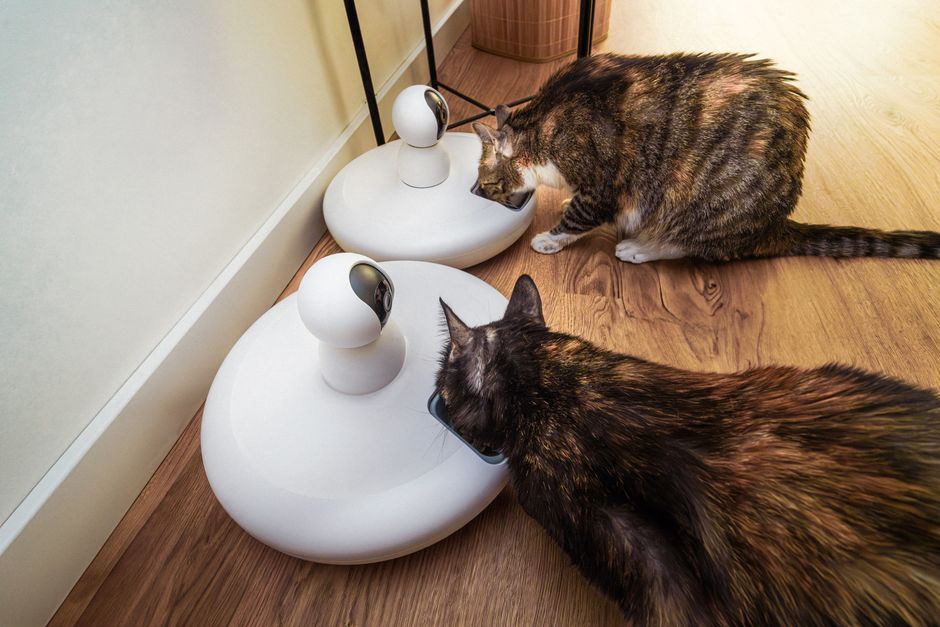
SureFlap is a UK company (based in Cambridge), and the SureFeed Microchip Pet Feeder is the go-to answer to a very specific problem: one cat eating another cat’s food, or a cat on prescription food that other pets shouldn’t have access to. The feeder bowl only unlocks for the microchip (or an RFID collar tag for pets without one) that you’ve registered to it, so it physically won’t open for the wrong animal - see the mechanism explanation above for how this actually differs from a camera-and-schedule feeder.
The base feeder works standalone; adding the SureFlap Hub connects it to the app for feeding history and low-food alerts, which is worth it if you want remote visibility rather than just the physical lock-out behaviour.
- Pros: the only option here that physically prevents the wrong pet accessing food, UK-based company with a well-established product
- Cons: app/remote visibility needs the separate Hub add-on, no built-in camera
Check SureFeed Microchip Feeder on Amazon UK →Affiliate link
Best Budget Camera: Petcube Cam
If you don’t need treat tossing or a feeder built in, the Petcube Cam is a simpler, cheaper way to just check in - HD live view, two-way audio, and motion/sound alerts, with no pan/tilt motor or barking-specific detection. It’s a sensible choice if you mainly want occasional reassurance rather than an interactive camera you’ll use daily.
- Pros: cheapest option here, no subscription required for core live view and alerts
- Cons: no pan/tilt or barking-specific detection, more basic feature set overall
Check Petcube Cam on Amazon UK →Affiliate link
Things Worth Checking Before You Buy
- Wi-Fi range - feeders and cameras are often in a kitchen or utility room with weaker signal than the living room; check your router reach or budget for a mesh extender
- Subscription costs - several camera brands (Furbo included) put their best features behind a monthly fee after an initial trial
- Battery vs mains - most feeders run on battery backup plus mains, so a power cut doesn’t leave your pet without food, but always check this for a specific model
- Hopper capacity - matters more for larger dogs going through more food per sitting than for cats on small, frequent portions
- Wet food compatibility - most auger-based feeders (PetLibro included) are dry food only; wet food needs a different mechanism (rotating tray feeders) not covered here, worth checking before assuming any smart feeder handles your pet’s actual diet
When You Don’t Need Any of This
If you’re home most of the day, or have a neighbour/dog walker checking in already, a camera mainly duplicates reassurance you already have - it’s most genuinely useful for households where pets are regularly left alone for a full working day. Similarly, a microchip feeder is solving a specific multi-pet problem; a single-pet household rarely needs one over a simple timed feeder, since there’s no other animal to lock out.
Frequently Asked Questions
Do microchip pet feeders work with any pet microchip?
SureFeed’s microchip feeders read standard ISO-compatible microchips used across the UK, and also support an RFID collar tag as an alternative for pets without a chip or if you’d rather not rely on chip-reading range/reliability alone.
Will a pet camera work if my dog or cat is anxious about being watched?
Most pets don’t register a small camera as anything unusual, but if separation anxiety is a genuine behavioural concern, a camera with two-way talk can help you reassure them remotely - it’s a monitoring tool though, not a treatment for anxiety, so persistent issues are worth discussing with a vet or behaviourist.
How accurate is portion control on a smart feeder really?
Good enough for general weight management on most auger-dispensed dry food feeders, but not laboratory-precise - kibble shape and size affects how consistently the auger dispenses a set portion. If your pet is on a vet-prescribed strict calorie count rather than general portion control, weigh a few dispensed portions manually against the app’s claimed amount before relying on it entirely.
What happens if the feeder loses Wi-Fi connection?
Scheduled feeding on all the feeders here continues to run on the device’s own internal clock even without Wi-Fi - the connection is needed for remote control, notifications and changing the schedule from the app, not for the feeder to keep dispensing on its existing programmed schedule. Microchip recognition on the SureFeed also works independently of Wi-Fi, since chip-reading happens locally at the feeder itself.
For the rest of your smart home setup, our smart home starter kit guide and security camera comparison cover the wider ecosystem these devices usually sit alongside.
Related guides
 GUIDE
Smart Home Gear That Actually Works in a Small Flat or Shared House (UK)
What to buy for communal areas vs your own room in a house share, and how…
 GUIDE
Smart TVs and Streaming Boxes for a Connected Home: UK Picks
Apple TV, Fire TV Stick and Chromecast compared for how well each plugs into your existing…
 GUIDE
Smart Dehumidifiers UK: Which Ones Are Actually Worth Automating
Meaco, Pro Breeze and EcoAir smart dehumidifiers compared for tackling UK damp and condensation, plus a…