Robot Lawn Mowers UK: Genuinely Hands-Off Garden Care, Compared
Husqvarna, Worx, Flymo and Gardena compared for UK lawns - including which models need a boundary wire and which now navigate by GPS alone.
Contents
- How Robot Mowers Actually Cut Grass (and Why It’s Better for Your Lawn)
- Wired Boundary vs Wire-Free (GPS/Vision) Navigation
- Quick Comparison
- Best Overall: Husqvarna Automower
- Best Wire-Free Option: Worx Landroid Vision
- Best Budget Option: Flymo EasiLife GO
- Best for Smart Home Integration: Gardena Sileno
- Theft: The UK-Specific Risk Most Buyers Underestimate
- UK-Specific Things to Check
- When a Robot Mower Isn’t Worth It
- Frequently Asked Questions
- Is a robot lawn mower safe around children and pets?
- How long does boundary wire installation actually take?
- How noisy are robot mowers, and can they run at night?
Robot lawn mowers have gone from novelty to genuinely mainstream in the UK over the last few years, helped along by models that no longer require burying a boundary wire around the entire garden. They’re not cheap, but for anyone who dreads Sunday mornings with a push mower - or who has a lawn size that makes mowing a real chore - they’re one of the more satisfying smart home purchases you can make. The right model depends on real numbers (incline rating, coverage rate, cutting width) more than the brand name on the box, and there’s a genuinely UK-specific concern - theft - worth planning for before you buy.
How Robot Mowers Actually Cut Grass (and Why It’s Better for Your Lawn)
Unlike a traditional mower that cuts once a week and collects the clippings, robot mowers work on a “little and often” principle - small rotating blades trim a few millimetres off the grass tip on frequent, short passes (often daily or every other day) rather than one big cut. The clippings are left on the lawn rather than collected, and because so little is cut each time, they’re fine enough to mulch back into the soil as a natural fertiliser rather than sitting as visible cuttings. This is a genuine agronomic advantage, not just marketing - the RHS and most lawn-care guidance recognises frequent light cutting as better for grass density and root health than the traditional weekly hack-back, since the grass is never stressed by having a third of its height removed at once. The trade-off is that the mower needs to run regularly through the growing season (roughly March to October in most of the UK) rather than being wheeled out occasionally.
Wired Boundary vs Wire-Free (GPS/Vision) Navigation
The single biggest decision is navigation type:
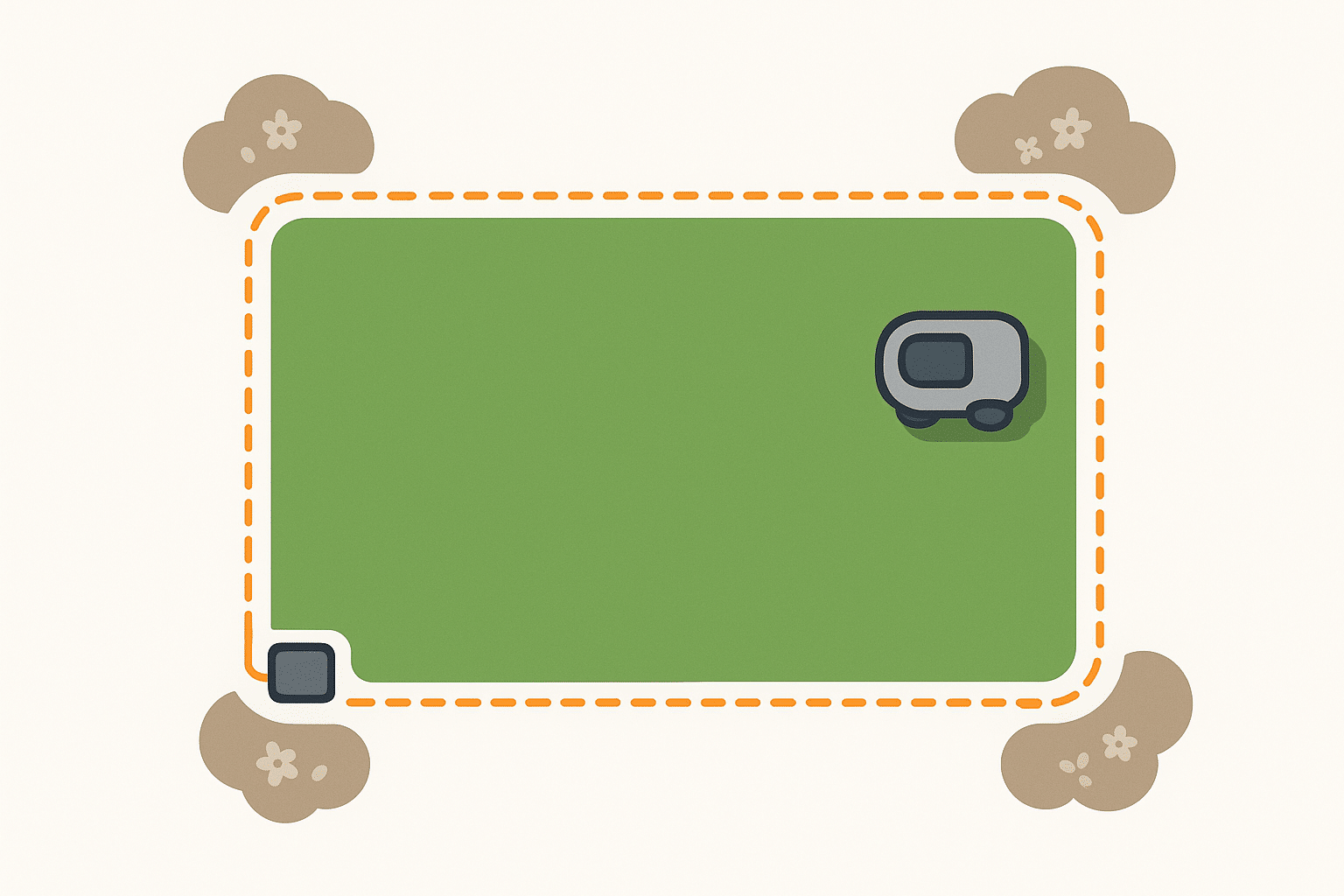
- Boundary wire models - a thin wire is laid (usually pegged down, sometimes buried) around the lawn’s edge and any no-go zones like flower beds. More fiddly to set up, but reliable and often cheaper
- Wire-free models - use GPS, cameras, or both to learn the garden shape without any wire. Quicker to set up and easier to change the mowing area later, but generally pricier and pickier about very complex or narrow garden layouts
Quick Comparison
| Product | Navigation | Max Incline | Typical Price | Best For |
|---|---|---|---|---|
| Husqvarna Automower 315X | Boundary wire + GPS assist | ~40% | £1,800-2,400 | Mid-size gardens, most reliable all-rounder |
| Worx Landroid (Vision models) | Wire-free, camera-based | ~35% | £1,200-1,800 | Complex garden shapes, no wire hassle |
| Flymo EasiLife GO | Boundary wire | ~25% | £500-700 | Smaller/simpler gardens, budget-friendly |
| Gardena Sileno | Boundary wire, app scheduling | ~35% | £600-1,000 | Mid-size gardens, smart home integration |
Best Overall: Husqvarna Automower
Husqvarna effectively invented the category and the Automower range remains the benchmark for reliability - models like the 315X combine a traditional boundary wire with GPS-assisted navigation, meaning the mower learns efficient routes across the garden rather than mowing in a purely random pattern. It handles slopes well (the 315X is rated for inclines up to roughly 40%, genuinely steep by UK garden standards), copes with UK weather without complaint, and the companion Automower Connect app gives you scheduling, mowing history, and - importantly given the theft risk covered below - GPS tracking and a PIN-locked start.
The trade-off is price and setup time - installing the boundary wire around a garden with borders, paths and obstacles takes a weekend, though most owners only do it once.
- Pros: most reliable and well-established brand, handles slopes and UK weather confidently, GPS-assisted efficient route learning, strong anti-theft features via GPS tracking and PIN lock
- Cons: most expensive of the four, boundary wire installation takes a full weekend
Check Husqvarna Automower on Amazon UK →Affiliate link
Best Wire-Free Option: Worx Landroid Vision
Worx’s Vision-series Landroid models use a camera and onboard processing to understand the garden’s layout without a boundary wire, which is the biggest single time-saver in this category if your garden shape changes often (kids’ paddling pool in summer, new flower bed, etc). You walk the mower around the boundary once during setup to teach it the shape, then it navigates visually from there. It’s rated for a maximum incline of around 35% - very close to the Automower’s figure despite the different navigation approach - so wire-free doesn’t mean a step down in slope handling, just a different way of understanding where the edges are.
Wire-free navigation is genuinely convenient but can be less precise right at garden edges compared to a physical boundary wire - check reviews for your specific garden layout (particularly narrow side-passages) before committing.
- Pros: no wire installation at all, easiest to reconfigure if the garden layout changes seasonally, incline handling close to the wired Automower
- Cons: can be less precise at garden edges than wired models, pricier than a comparable wired mower
Check Worx Landroid on Amazon UK →Affiliate link
Best Budget Option: Flymo EasiLife GO
Flymo is a familiar name in UK gardens, and the EasiLife GO range brings robot mowing down to a more approachable price point for smaller, simpler lawns. It’s a straightforward boundary-wire mower without the GPS route-planning of the pricier Husqvarna models, and its incline rating (around 25%) is noticeably more modest than the other three here - worth checking against your own garden’s slope before assuming any robot mower will cope, since a rear lawn with even a moderate rise can exceed what this range is rated for. For a modest rectangular or L-shaped flat-ish lawn, that’s not a meaningful downside.
- Pros: cheapest entry point into robot mowing, familiar UK brand with wide parts/support availability
- Cons: no GPS route planning, best suited to simpler lawn shapes rather than complex layouts, lowest incline rating of the four
Check Flymo EasiLife on Amazon UK →Affiliate link
Best for Smart Home Integration: Gardena Sileno
Gardena’s Sileno range uses a boundary wire like the Automower and EasiLife, but leans more heavily into app-based scheduling and works with Gardena’s wider smart garden ecosystem - useful if you’re also considering Gardena’s smart irrigation controllers (see our smart garden irrigation guide) and want mowing and watering managed from the same app family. It handles mid-size gardens well, with an incline rating (~35%) comparable to the Worx, and, like the Automower, needs a weekend for the initial wire installation.
- Pros: pairs neatly with Gardena’s smart irrigation ecosystem under one app, solid mid-range price-to-capability balance, respectable incline handling
- Cons: still needs the same weekend wire installation as the Automower
Check Gardena Sileno on Amazon UK →Affiliate link
Theft: The UK-Specific Risk Most Buyers Underestimate
Robot mowers left running or docked in a front or side garden are a genuine, well-documented theft target in the UK - they’re valuable, portable, and often sitting in plain view of a street or shared driveway. This is worth planning for at purchase time, not as an afterthought: check whether your chosen model has GPS tracking (standard on Husqvarna’s Connect models, increasingly common elsewhere), a PIN code required to restart the mower if it’s picked up and moved, and an audible alarm that triggers on unauthorised lifting. Separately, check with your home insurer whether garden equipment left outside is actually covered under your policy - many standard contents policies exclude or limit cover for items kept outdoors, which a several-hundred-to-several-thousand-pound mower can fall foul of if you haven’t checked.
UK-Specific Things to Check
- Rain - most models are weatherproof and happily mow in light rain, but check whether yours pauses and returns to base automatically for heavy downpours
- Slopes - UK gardens are rarely perfectly flat; check the maximum incline rating against your lawn before buying - the four models here range from roughly 25% to 40%, a meaningful spread
- Garden size limits - models are rated for a maximum square metreage; measure your lawn (not the whole garden) before choosing a model
- Winter storage - most robot mowers need to be brought in and the charging base left connected, or a frost-proof setup used, over UK winters
When a Robot Mower Isn’t Worth It
Worth being honest here: a very small lawn (well under 100m², a typical small terraced-house back garden) rarely justifies the cost - a decent cordless push mower does the job in ten minutes and costs a fraction of even the budget Flymo option. Equally, a garden with lots of narrow gaps, steps between levels, or a layout that changes constantly (a young family’s garden full of temporary play equipment) can be a genuinely frustrating fit for any of these, wired or wire-free - worth reading reviews for your specific garden shape, not just the product spec sheet, before committing to the wire-installation weekend.
Frequently Asked Questions
Is a robot lawn mower safe around children and pets?
Modern robot mowers use rotating blades that lift on contact with an obstacle and include lift/tilt sensors that stop the blades if the mower is picked up, but most manufacturers still recommend supervision around very young children and pets unfamiliar with the mower, at least until everyone’s used to it being active in the garden.
How long does boundary wire installation actually take?
For a typical mid-size garden with a few obstacles (flower beds, a shed, a patio), budget a full weekend for laying and pegging the wire and testing the mower’s initial mapping runs - it’s a one-off job, and adjusting the wire afterwards for a layout change is far quicker than the original install.
How noisy are robot mowers, and can they run at night?
Most robot mowers run at roughly 55-65dB, quieter than a traditional mower and generally considered acceptable for daytime and evening operation, but check your specific model’s rating and consider your neighbours before scheduling overnight runs - some UK local authorities and housing developments have noise restrictions that could technically apply, even though robot mowers are quiet enough that this is rarely an actual issue in practice.
If you’re automating the rest of the garden too, our smart garden irrigation guide covers watering systems that pair well alongside a robot mower.
As an Amazon Associate we earn from qualifying purchases. This doesn’t affect our recommendations.
Related guides
 GUIDE
Smart Home Gear That Actually Works in a Small Flat or Shared House (UK)
What to buy for communal areas vs your own room in a house share, and how…
 GUIDE
Smart TVs and Streaming Boxes for a Connected Home: UK Picks
Apple TV, Fire TV Stick and Chromecast compared for how well each plugs into your existing…
 GUIDE
Smart Dehumidifiers UK: Which Ones Are Actually Worth Automating
Meaco, Pro Breeze and EcoAir smart dehumidifiers compared for tackling UK damp and condensation, plus a…