Smart Water Leak Detectors UK: Catching a Burst Pipe Before It’s a Disaster
Burst pipes and slow leaks are one of the most expensive home insurance claims in the UK. Smart water sensors catch them before they cause serious damage.
Contents
- How These Sensors Actually Detect Water
- Where to Put Them
- Quick Comparison
- Best Overall: Aqara Water Leak Sensor
- Best No-Hub Option: SwitchBot Water Leak Detector
- Best for Apple HomeKit: Eve Water Guard
- Going Further: Automatic Shut-Off Valves
- Does This Affect Your Insurance?
- Frequently Asked Questions
- How many leak sensors do I actually need?
- Will a leak sensor notify me if I’m not home?
- Can a leak sensor give false alarms?
- What happens if the sensor’s battery dies without me noticing?
- Our Recommendation
Escape of water is one of the most common - and most expensive - home insurance claims in the UK, regularly outpacing fire and theft combined in industry claims data, with average claim costs frequently running into several thousand pounds once flooring, plastering and drying-out are all accounted for. A slow leak under a sink or behind a washing machine can run for weeks before it’s noticed, by which point you’re dealing with rotten flooring, damaged skirting, and possibly a damp-related mould problem. A smart water leak sensor costs a few pounds and can alert you to a problem within seconds - but which one is actually right for your house depends on more than just price.
How These Sensors Actually Detect Water
All three sensors here use the same basic mechanism - two exposed metal contacts on the underside that complete an electrical circuit the instant they touch water, triggering an alert within a second or two. The meaningful difference is coverage area: a point sensor like the Aqara or SwitchBot only detects water that actually reaches its footprint (a few centimetres square), so placement directly under the most likely leak source matters a lot. The Eve Water Guard instead uses a trailing detection cable rather than just the unit’s own base, letting you snake it along a skirting board or around the base of a boiler, covering a meaningfully wider area from one sensor - which is where its higher price partly comes from, not just the Thread radio.
Where to Put Them
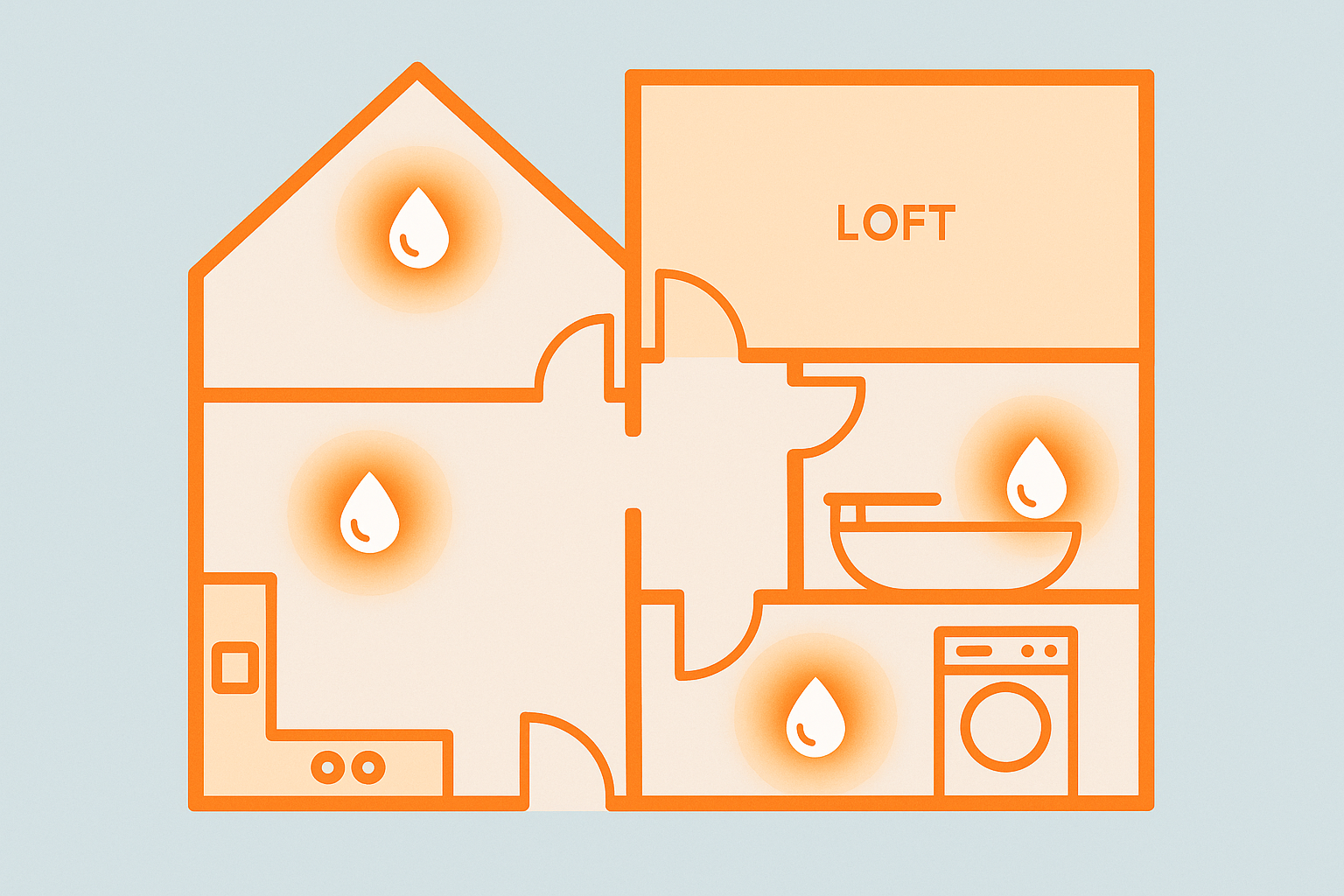
- Under the kitchen sink - the single highest-risk spot in most homes, place it flat on the cabinet floor directly below the pipe joints, not against the back wall where a leak might pool elsewhere first
- Behind/under the washing machine and dishwasher - hose failures are extremely common, and these appliances are often the last thing checked since the leak is hidden behind the unit itself
- Next to the boiler - combi boilers can leak from the pressure relief valve or internal seals; place the sensor at the lowest point near the boiler’s drain point, not tucked against a wall where water might not reach it
- Bathroom floor, near the toilet base and bath panel - avoid placing directly in a spot that gets normal splash from showering, which will cause false alarms; a few centimetres back from the immediate splash zone but still low enough to catch a genuine leak is the balance to aim for
- Loft, near any water tank or pipework - especially in older homes with cold water storage tanks; check battery levels here more often than elsewhere, since a dead sensor in the loft is easy to forget about until it’s too late
Quick Comparison
| Product | Connection | Detection Method | Typical Price | Best For |
|---|---|---|---|---|
| Aqara Water Leak Sensor | Zigbee (needs Aqara Hub) | Point contact, ~2yr CR2032 battery | £15-20 per sensor | Reliable, hub-based coverage across the house |
| SwitchBot Water Leak Detector | Bluetooth, optional Hub Mini | Point contact, replaceable coin battery | £15-25 | Existing SwitchBot ecosystem |
| Eve Water Guard | Thread (Apple HomeKit) | 1.5m trailing detection cable, mains or battery | £70-90 | Apple Home users, widest coverage per unit |
Best Overall: Aqara Water Leak Sensor
The Aqara Water Leak Sensor is small, battery-powered (a single replaceable CR2032 coin cell, rated for roughly 2 years of standby), and pairs over Zigbee via an Aqara Hub. Its two metal contacts on the underside detect water within seconds and trigger an instant push notification. Because it runs on Aqara’s hub rather than relying solely on Wi-Fi, it stays reliable even if your Wi-Fi network has issues - a genuine advantage for a device whose entire job is to alert you during an emergency, when a router reboot or ISP outage is exactly the kind of thing that could otherwise silently disable a Wi-Fi-only sensor at the worst moment. Its small point-contact footprint means placement precision matters more than with the Eve - a couple of centimetres off from where water actually pools can mean a delayed alert rather than an instant one.
- Pros: cheap enough to fit several around the house, reliable Zigbee connection independent of Wi-Fi, long battery life on a standard replaceable coin cell
- Cons: requires an Aqara Hub if you don’t already own one, adding to the cost of a first sensor; small point-contact footprint means placement precision matters
Check Aqara Water Leak Sensor on Amazon UK →Affiliate link
Best No-Hub Option: SwitchBot Water Leak Detector
The SwitchBot Water Leak Detector works over Bluetooth on its own for local alerts, or via the SwitchBot Hub Mini for remote push notifications when you’re away from home. It sounds a genuinely loud onboard alarm (useful if you’re home but not looking at your phone - the audible alert alone can be enough to catch a leak fast) alongside the app notification once a hub is connected. If you already have SwitchBot devices (including the Curtain 3 from our blinds guide), this slots into the same app and hub with no extra setup.
- Pros: works standalone without any hub for local alerts, loud onboard audible alarm, integrates with existing SwitchBot devices
- Cons: Bluetooth-only range is limited without the Hub Mini, and remote (away-from-home) alerts need that hub
Check SwitchBot Water Leak Detector on Amazon UK →Affiliate link
Best for Apple HomeKit: Eve Water Guard
The Eve Water Guard is a HomeKit-native sensor that uses Thread for fast, local alerts - no cloud round-trip needed, which matters when you want the fastest possible warning. Its real differentiator is the roughly 1.5-metre trailing detection cable rather than a fixed point contact, which you can route along a skirting board, around a boiler’s base, or in a loop around a washing machine’s footprint - genuinely wider coverage from one sensor than a point-contact unit gives you, which is worth weighing against its considerably higher per-unit price. It can run on mains power via USB where a permanent installation makes sense (a utility room, under a boiler), or on battery for more flexible placement, and integrates cleanly with the rest of an Apple Home setup covered in our HomeKit guide.
- Pros: fastest local alerts via Thread, ~1.5m trailing detection cable covers a genuinely wider area than a point-contact sensor, mains or battery power options
- Cons: significantly more expensive per sensor than Aqara or SwitchBot, Apple ecosystem only
Check Eve Water Guard on Amazon UK →Affiliate link
Going Further: Automatic Shut-Off Valves
For the highest level of protection, some households pair leak sensors with a smart shut-off valve fitted to the mains water supply, which closes automatically the moment a leak is detected anywhere in the house - rather than just alerting you to a problem you still have to drive home to fix. This is a bigger, plumber-fitted project (typically fitted at the stopcock, and needing an electrician-adjacent installation since it needs power) rather than a stick-on sensor, running into several hundred pounds installed rather than a few pounds per sensor, but it’s worth considering if you travel often, have a holiday let, or have previously had a significant leak. If you’re building this out via Home Assistant rather than a manufacturer’s own app, our first automation guide covers the trigger/condition/action logic you’d use to wire a leak sensor straight to a valve shut-off.
Does This Affect Your Insurance?
Some UK insurers offer reduced premiums or excess for homes with leak detection fitted, though this varies significantly by provider and is far more commonly offered for a properly plumbed-in automatic shut-off system than for a handful of stick-on point sensors - worth checking the specific wording with your own insurer rather than assuming any leak sensor qualifies. See our guide on how smart home tech affects your home insurance for what to check with your own insurer, and keep any purchase receipts or installation documentation in case a provider asks for evidence at claim time.
Frequently Asked Questions
How many leak sensors do I actually need?
For most homes, three to five sensors covering the highest-risk spots (kitchen sink, washing machine, boiler, and one bathroom) gives good coverage without needing to sensor every pipe in the house. Add more if you have a loft tank or multiple bathrooms.
Will a leak sensor notify me if I’m not home?
Only if it’s connected to a hub with internet access (Aqara Hub, SwitchBot Hub Mini, or a Thread border router for Eve) - a purely Bluetooth-only connection typically only alerts you within range of the sensor itself.
Can a leak sensor give false alarms?
Yes, if placed somewhere that gets normal condensation or splash - a bathroom floor right next to a shower, or a spot near an un-lagged cold water pipe that sweats in summer, can trigger a false positive. Placement a little back from normal splash zones, while still low enough to catch a genuine leak, avoids most of these.
What happens if the sensor’s battery dies without me noticing?
All three send a low-battery notification well before the battery actually dies, but this only reaches you if the sensor is still connected to its hub - it’s worth doing a manual battery-level check across all your sensors every few months (most apps show this on the device list at a glance) rather than relying purely on the low-battery push notification arriving.
Our Recommendation
For most homes: Aqara Water Leak Sensor - reliable, hub-based, and inexpensive enough to fit three or four around the house. Apple households should look at Eve Water Guard for the Thread-based local speed advantage and the wider coverage its trailing cable gives per unit, particularly around a boiler or washing machine where a point sensor might miss water pooling slightly off to one side. Whichever you choose, the important thing is coverage and correct placement - a £15 sensor under the sink, positioned where water will actually reach it first, is cheap insurance against a five-figure water damage claim.
As an Amazon Associate we earn from qualifying purchases. This doesn’t affect our recommendations.
Related guides
 GUIDE
Should You Put Smart Home Devices on a Separate VLAN? A UK Guide
Every smart home device on your network is, from a security standpoint, a small computer running…
 GUIDE
Smart Home Gear That Actually Works in a Small Flat or Shared House (UK)
What to buy for communal areas vs your own room in a house share, and how…
 GUIDE
Smart TVs and Streaming Boxes for a Connected Home: UK Picks
Apple TV, Fire TV Stick and Chromecast compared for how well each plugs into your existing…